MDAnalysis 2025 Events - Recap of the User Group Meeting and Workshops
15 Dec 2025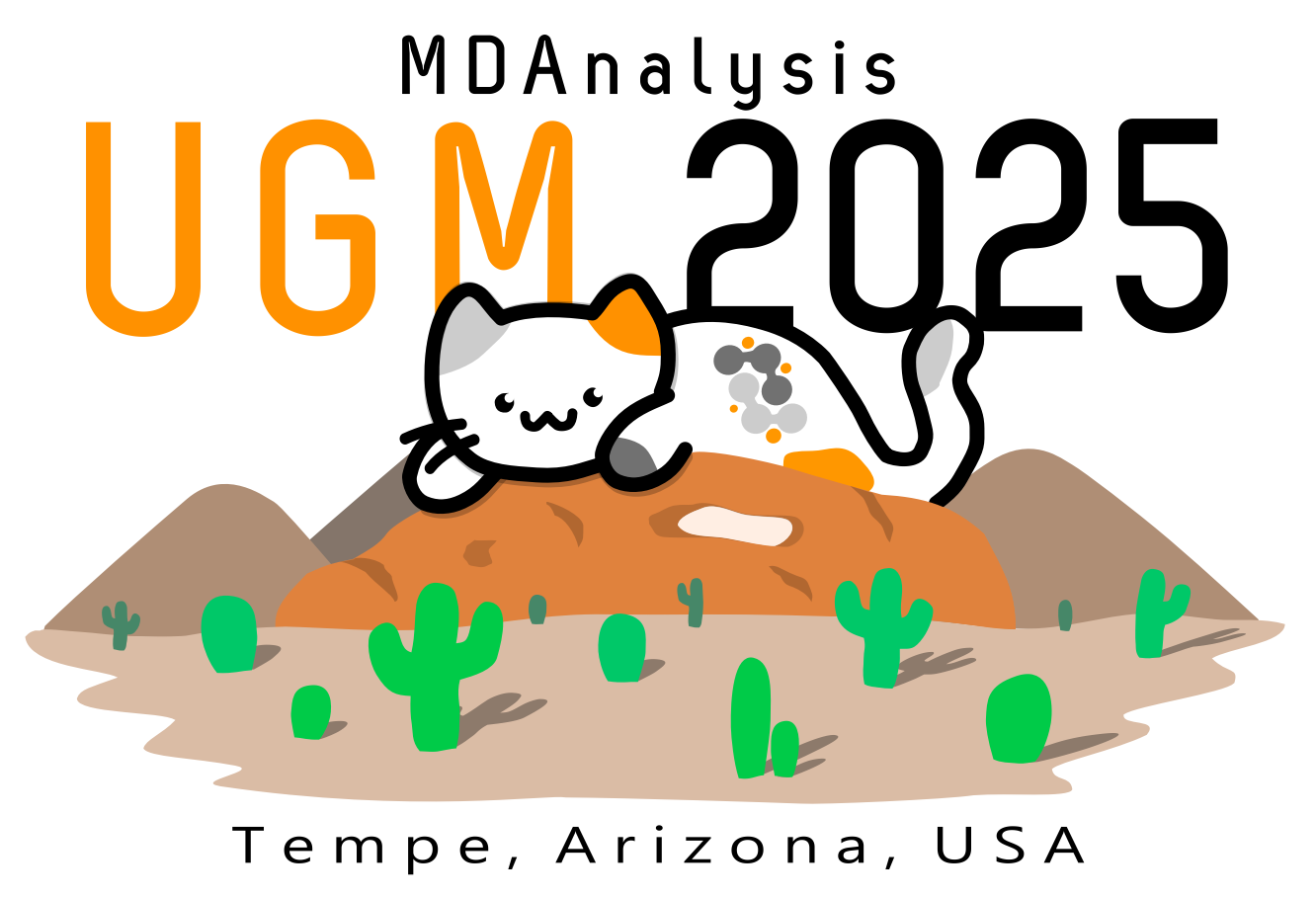
Here’s our quick recap on our community events throughout 2025. Our flagship gathering was the third MDAnalysis User Group Meeting (UGM) in Tempe, Arizona, which brought together researchers and developers for three days of science, tutorials, workshops, and collaboration.
MDAnalysis UGM (User Group Meeting)
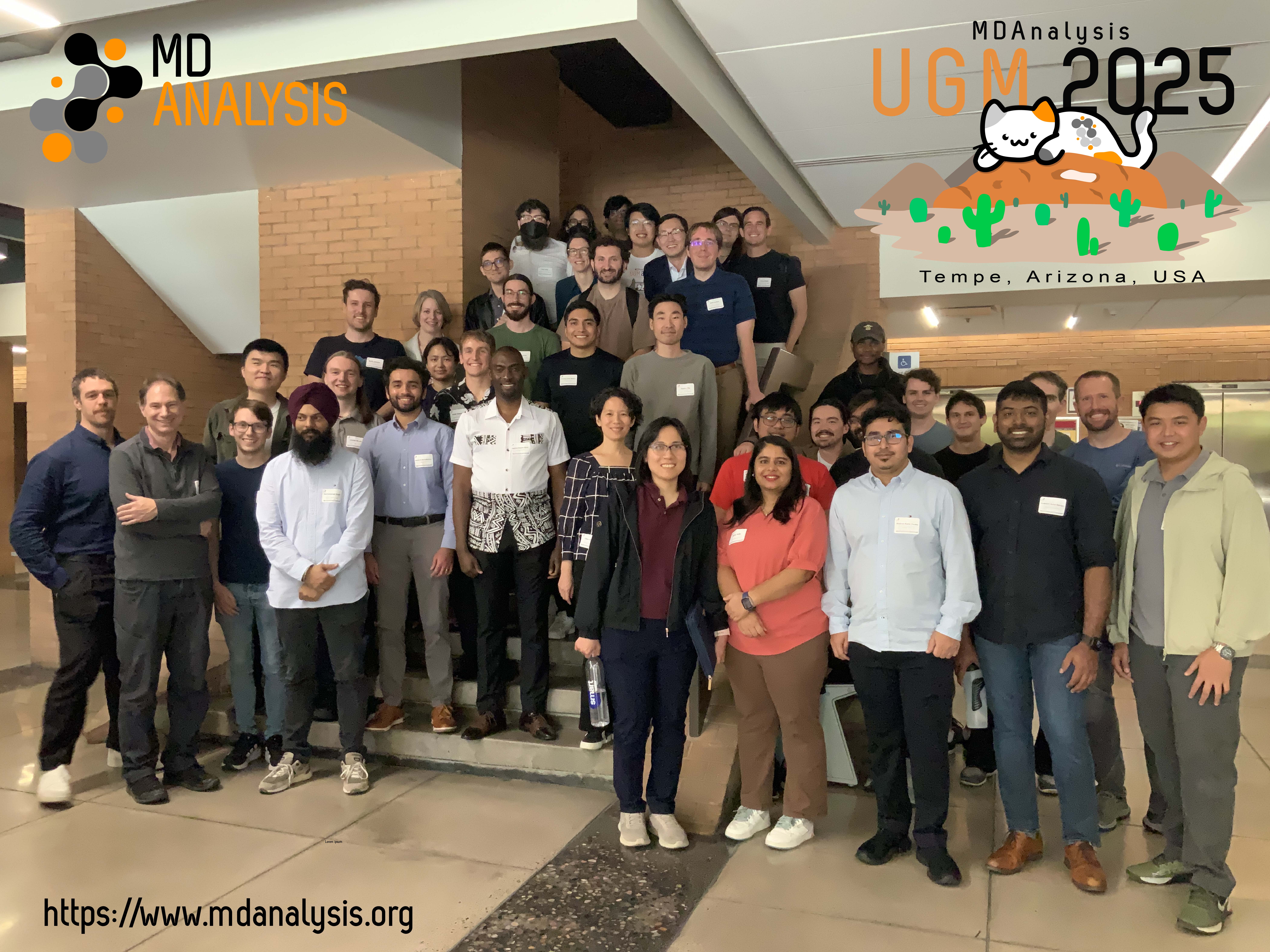
From November 9–11, 2025, MDAnalysis users and developers convened in Tempe, Arizona for the third MDAnalysis UGM (User Group Meeting). Hosted at Arizona State University (ASU) in the Center for Biological Physics and Department of Physics, the hybrid-format meeting featured contributed talks, posters, lightning talks, and hands-on workshops. In-person registration reached capacity, and we were grateful for the strong interest from the community; online attendance remained free for those who followed along remotely.
The program emphasized streaming and inline analysis of molecular dynamics trajectories—building on ongoing work supported by a U.S. National Science Foundation Elements award and our December 2024 online streaming developer workshop. Talks and tutorials covered biomolecular simulations, soft matter and materials science, drug discovery, machine learning, visualization, and open-source tooling for molecular simulation analysis.
Keynote Speakers
Two keynote speakers anchored the scientific program:
- Sunday, November 9 — Dr. Matthias Heyden (Arizona State University) opened the meeting with a keynote on Sub-Picosecond Timescale Information in Microsecond Simulations, highlighting how streaming and interactive molecular dynamics workflows can unlock high time-resolution insight from long simulations.
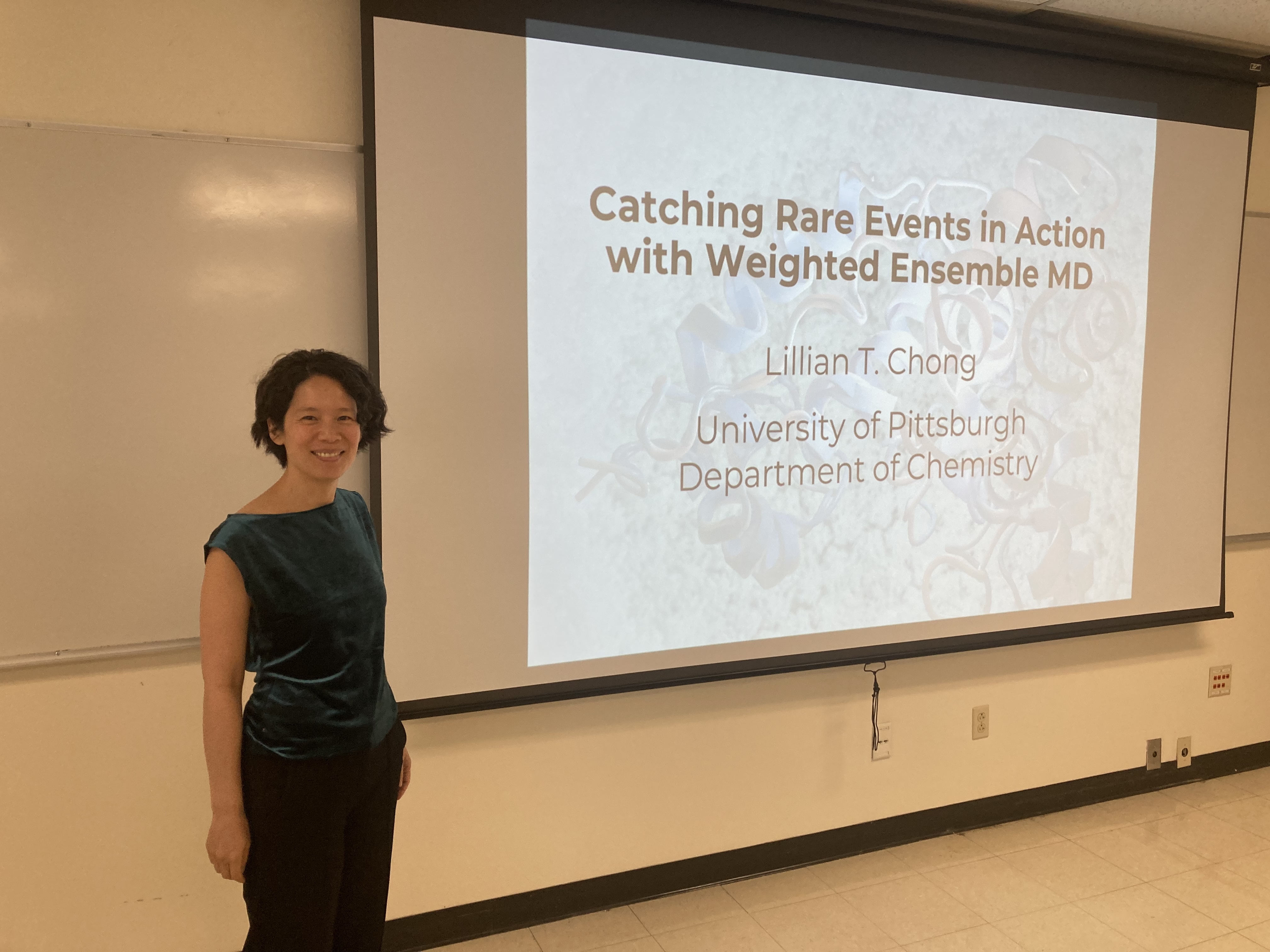
- Monday, November 10 — Dr. Lillian Chong (University of Pittsburgh) delivered a keynote on From Protein Structure to Function: Weighted Ensembles Beyond Machine Learning, connecting rare-event sampling with WESTPA and broader biomolecular simulation challenges.
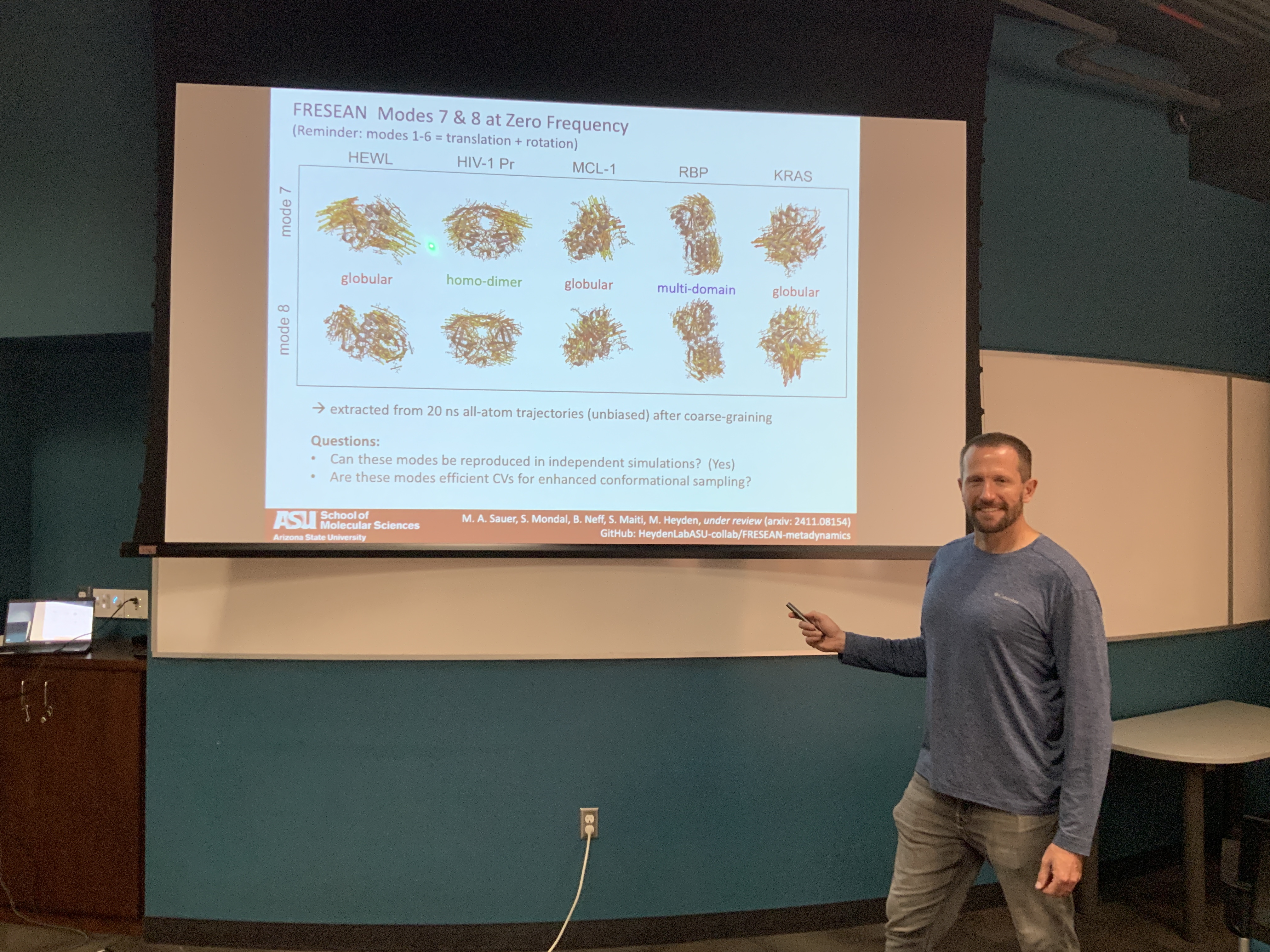
Contributed presentations spanned membrane biophysics, force-field development, enhanced sampling, visualization, MDAKit development, and community infrastructure. Lightning talks on Monday and Tuesday gave early-career researchers and new contributors a platform to share work in a fast-paced format.
For the full program, see the UGM schedule. We invite you to explore the MDAnalysis/UGM2025 GitHub repository, where presenters deposited slides, notebooks, and workshop materials.
Partners and Sponsors
We would like to thank our partners and sponsors for helping us make the 2025 MDAnalysis UGM such a success!
The Future of MDAnalysis UGMs
We are grateful to the Chan Zuckerberg Initiative (CZI) and the U.S. National Science Foundation for supporting outreach and streaming-related development that helped make the 2025 UGM possible. As we plan future community gatherings, we continue to seek partners who can help sustain this annual tradition.
If you are interested in sponsoring, hosting at your own institution, or joining the organizing committee for any future UGMs, please get in touch with us on Discord (to join the Discord server, use the invitation link, https://discord.com/invite/fXTSfDJyxE), GitHub Discussions, or by emailing [email protected]!
Workshops and Tutorials at the UGM
Unlike 2024, when we offered four standalone online and hybrid training workshops throughout the year, our primary hands-on training in 2025 took place during the UGM itself. Community partners and the MDAnalysis core developer team led tutorials and master classes across all three days.
November 9: MDAnalysis Streaming Workshop
On the first afternoon, Dr. Matthias Heyden, @amruthesht, @ljwoods2, and colleagues led a streaming workshop on interactive molecular dynamics (IMD) and trajectory streaming in MDAnalysis, including theory, implementation details for IMDv3, live demonstrations, and a hands-on session. The program also featured a talk by @jpkrowe on integrating MDAnalysis streaming analysis with WESTPA propagators—work connected to our Google Summer of Code 2025 collaboration. Materials are available in the Streaming workshop folder and build on the imd-workshop-2024 repository.
November 10: MDAnalysis Master Classes
Monday afternoon featured short master classes from the MDAnalysis core developer team:
- Topology attributes and DSSP — @orbeckst
- Fast distance calculations with Distopia — @hmacdope
- Contributing to MDAnalysis and MDAKits — @IAlibay
These sessions were followed by an open Q&A with core developers. Materials are in the MasterClasses folder.
November 11: Visualization and Open Molecular Science Workshops
The final day focused on visualization and workflows from the broader open molecular software ecosystem:
- Visualization workshop — @bradyajohnston and @yuxuanzhuang taught participants how to visualize molecular systems using MDAnalysis with Molecular Nodes and Blender. Materials are in the Visualization workshop folder.
- Open Force Field workshop — led by Jeffrey Wagner and @jaclark5
- Open Free Energy workshop — an introduction to alchemical free energy calculations, led by @mikemhenry, Alyssa Travitz, and @IAlibay
- OpenADMET workshop — led by @hmacdope
Workshop materials for the OpenFF, OpenFE, and OpenADMET sessions are linked from the UGM2025 workshops README.
Acknowledgements
A special thanks goes out to everyone who helped make the 2025 UGM a success, including participants, speakers, workshop leaders, poster presenters, the organizing committee, and our sponsors! If you or your organization are interested in partnering with MDAnalysis to organize future workshops or UGMs, you are always welcome to fill out our Google form or email [email protected].
To stay up-to-date on all MDAnalysis event offerings, be sure to follow our News, LinkedIn, and Bluesky pages.