This marks our seventh consecutive year participating as an independent GSoC organization.
A big thank you goes out to Google for supporting these three exciting projects.
We’re looking forward to getting started!
This project will implement WESTPAParser and WESTPAReader inside westpa/westpa, exposing WESTPA’s HDF5 Framework simulation data as a standard MDAnalysis Universe. Post-simulation analysis currently requires custom boilerplate code via w_crawl which this project will replace with a single command, making the entire MDAnalysis toolkit accessible on WESTPA data.
Kunj is an undergraduate student at PES University, pursuing a Bachelor of Technology in Computer Science and Engineering. He has always had an interest in various fields of science and technology since his early school days. In his free time, he listens to music, plays different musical instruments and enjoys cooking as well.
This project will develop a browser-based, real-time dashboard for molecular dynamics simulations using the new IMDv3 streaming protocol, enabling live monitoring, analysis, and visualization of running simulations. The dashboard will leverage imdclient and MDAnalysis to receive and analyze data streams from running simulations.
Pardhav is an undergraduate student from India pursuing a Bachelors in Computer Science and Engineering from Vellore Institute of Technology (Vellore) and a BS in Data Science and Applications from Indian Institute of Technology (IIT) Madras.
This project intends to add web retrieval functionality to MDAnalysis by augmenting the existing fetcher module. By introducing new fetchers,
it is intended to allow MDAnalysis to download structures and trajectories from external databases such as AlphaFold and the Molecular Dynamics Data Bank by passing downloaded data to the in-built Universe class. Additionally, this project intends to introduce a new suite of functions that is capable of retrieving any molecular data from any database supporting REST API.
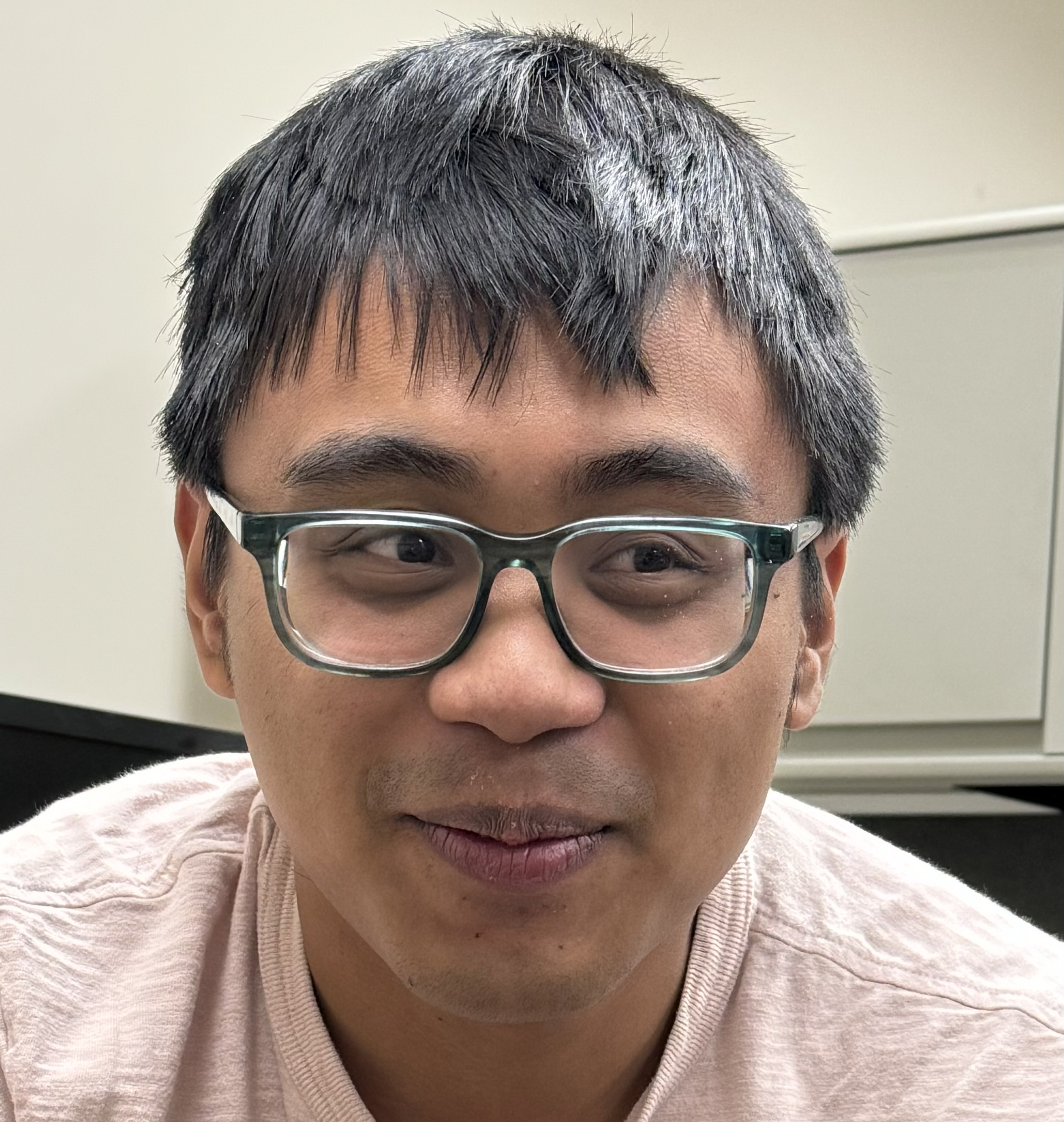
Joshua Raphael Uy is a Physics Ph.D student at Arizona State University. He earned a Bachelor of Science in Physics, a Bachelor of Arts in
Mathematics at Miami University in Oxford, Ohio, and a Master in Science in Physics at Arizona State University. He has a bio page and a Linkedin.
To follow this project, you can check out Josh’s blog.
MDAnalysis has been accepted as an organization for Google Summer of
Code (GSoC) 2026! If you are interested in working with us and you
are new to open source, please read the advice and links below to learn how you can apply to participate in GSoC 2026 with MDAnalysis.
The application window deadline is March 31, 2026 - 18:00 UTC.
As part of the application process you must familiarize
yourself with Google Summer of Code 2026, including eligibility requirements, timelines, and generally how the program works.
We are looking forward to all applications from any new and beginner
open source contributors or students over 18 years old; see a full list of the eligibility requirements in the GSoC FAQ. Projects
are scoped as either 90-hour (small), 175-hour (medium) or 350-hour (large) size. The
duration can be extended from the standard 8 weeks to up to 12 weeks (for small projects), or from the standard 12 weeks up to 22 weeks (for medium or large projects).
For GSoC, MDAnalysis collaborates with other projects that have direct links with MDAnalysis and where it is especially useful to draw on the combined mentoring expertise.
This year, MDAnalysis is joining forces with WESTPA and Molecular Nodes. Applicants who want to work with one of the collaborating projects should familiarize themselves with MDAnalysis and the project that they are interested in. GSoC projects with either WESTPA or Molecular Nodes will be mentored by experts from the collaborating project and MDAnalysis.
Project Ideas
If you have your own idea about a potential project we’d love to work with you
to develop this idea; please write to us on the GSoC with MDAnalysis discussion forum to discuss it there.
We also have listed several possible projects for you to work on. Our
initial list of ideas (see summaries in the table below) contains various
projects of different scope and with different skill requirements. However,
check the ideas page — we might add more ideas after the posting date of
this post.
You must meet our own requirements if you want to be a GSoC
Contributor with MDAnalysis this year (read all the docs behind these
links!) and read the points below for the application process. You must also meet the GSoC eligibility criteria. Our GSoC FAQ collects common questions from applicants.
Participate in a video interview with developers of MDAnalysis and/or one of the partner organizations. You will be invited for interview based on your pre-proposal.
Submit your full GSoC application. You will be invited to submit your application based on your video interview.
Code of Conduct
The MDAnalysis community values diversity and is committed to providing a
productive, harassment-free environment to every member. Our Code of Conduct
explains the values that we as a community uphold. Every community member (and every
GSoC Contributor) agrees to follow the Code of Conduct.
Familiarize yourself with MDAnalysis and relevant partner projects
As a start to get familiar with MDAnalysis and open source development you
should follow these steps:
The MDAnalysis Trailer on YouTube
is a one minute introduction to MDAnalysis.
There are also additional introductory videos available to give you an idea of what problems MDAnalysis is solving.
Complete the Quick Start Guide
Start by installing the MDAnalysis package. We have a Quick Start Guide explaining the basics of MDAnalysis. You should go through it at least once to understand how MDAnalysis is
used. Continue reading the User Guide to learn more.
Learn More About WESTPA and Molecular Nodes
As some of the project ideas represent collaboration between MDAnalysis and other partner software projects, you should follow the recommended steps linked here to familiarize yourself (as relevant) with WESTPA and/or Molecular Nodes.
Interactions and engagement with MDAnalysis
GSoC contributors with MDAnalysis should demonstrate that they have been seriously engaged with the MDAnalysis project (and/or with a relevant partner software project). Submitting a pull request is a great way to know you as a good candidate. As is relevant to the GSoC project idea you are interested in, you should submit your PR in one of the following repositories:
We have a list of easy bugs and suggested GSOC Starter issues to work on in our issue tracker on GitHub. If you want to dive deeper, we encourage you to tackle some of the other issues in our issue tracker or create a new one. We also appreciate contributions which add more tests or update/improve our documentation. Note that some of the GSoC 2026 Project Ideas include related issues that you might want to explore.
We ask you to submit a short pre-proposal so that we can evaluate your understanding of the proposed project. In this pre-proposal you tell us what project you’d like to work on, what you consider the major challenges, and how you plan to solve the problem. MDAnalysis developers will review your proposal and then either invite you to continue with your application and participate in a video interview or tell you that we will not consider your application. Please note that this decision is final, and applicants should only submit one pre-proposal. A rejection is not a judgment on you or your abilities but an assessment of how well you fit the specific requirements of MDAnalysis as a scientific software package — we much rather you spend your energies on contributing to another exciting GSoC project than being rejected later by MDAnalysis.
We require GSoC applicants to submit a pre-proposal that will determine who is then invited to participate in a video interview. If you are invited to participate in an interview and ultimately submit a full application, the pre-proposal will help you gather some of the information you will need to include.
Submit your pre-proposal via our pre-proposal submission formby March 9, 2026. The submission form will go live a few days after this post is available from Feb 28, 2026.
❗Do not use generative AI to develop or write your pre-proposal. We need to hear your ideas and voice.
You are allowed to use AI tools for grammar and spell checking and for translation into English although we are more than happy to read your proposal in your own English words.
You should prepare the following information for your pre-proposal:
Email address
GitHub handle
Real name (optional)
Certify that you did not use AI tools to develop or produce the pre-proposal.
Basic information on your background (e.g., education, relevant experience with MDAnalysis and molecular dynamics or computational physics/chemistry/materials)
Project title
Project size (90h, 175h, 350h)
Problem: Describe the problem to be solved. What is the background? What is the overarching question? You can also comment on why this is an interesting or difficult problem. Clearly define the overall goal of what you want to find out.
Approach: Describe how you are going to reach your goal (i.e., answer the overarching question). Which algorithms are you going to use? Are there any libraries or other packages you want to use? Do you need to research different solutions? Be as concrete as possible; you want to convince your audience that it is feasible to solve this problem and you have an idea how to tackle it.
Objectives: Use a numbered list to state 3–5 measurable non-trivial outcomes that you need to achieve in order to reach the overall goal. These are the milestones that you have to reach; they are possibly dependent on each other. For each objective it must be clear how to decide if you fulfilled it or not. Objectives are formulated in terms of actions and deliverables.
Interactions: Describe the interactions you had with maintainers from MDAnalysis (or WESTPA/Molecular Nodes if you plan on working on a collaborative project). Be specific and link to specific instances of interactions (e.g. Pull Requests) if possible. (500 words)
Participate in a video interview (by invitation)
Applicants who are invited for a video interview will be contacted no earlier than 72 hours after they submit their pre-proposal. During the interview (15 minutes), you will discuss your pre-proposal with 1-2 developers. The video may be recorded for evaluation by other developers/mentors. During the interview, you will be required to share your (full) screen and respond live to questions. The interview may involve live programing and discussions of code sections of MDAnalysis that are relevant for your project. The interview will be conducted using Google Chats or an equivalent video conferencing software.
Submit full application (by invitation)
If you pass the interview stage, you will be invited to submit your full GSoC application through the GSoC site (starting March 16, 2026). We will only review invited applications.
❗Do not use generative AI to develop or write your application. We need to hear your ideas and voice.
You are allowed to use AI tools for grammar and spell checking and for translation into English although we are more than happy to read your application in your own English words.
Final remarks
Submit your pre-proposal before March 9, 2026, but the earlier the better! We will then let you know via the email you provide in the pre-proposal submission form if you have been selected to participate in a video interview and ultimately submit a full application. The GSoC contributor application period opens on March 16, 2026.
Feel free to ask any questions on the discussion forum. We are also happy to chat on our MDAnalysis Discord server in the #gsoc channel (join with the public invitation link). Please note that MDAnalysis as an organization highly values transparency and therefore we strive to conduct all discussions in public forums so please ask questions publicly and not via direct messages or emails.
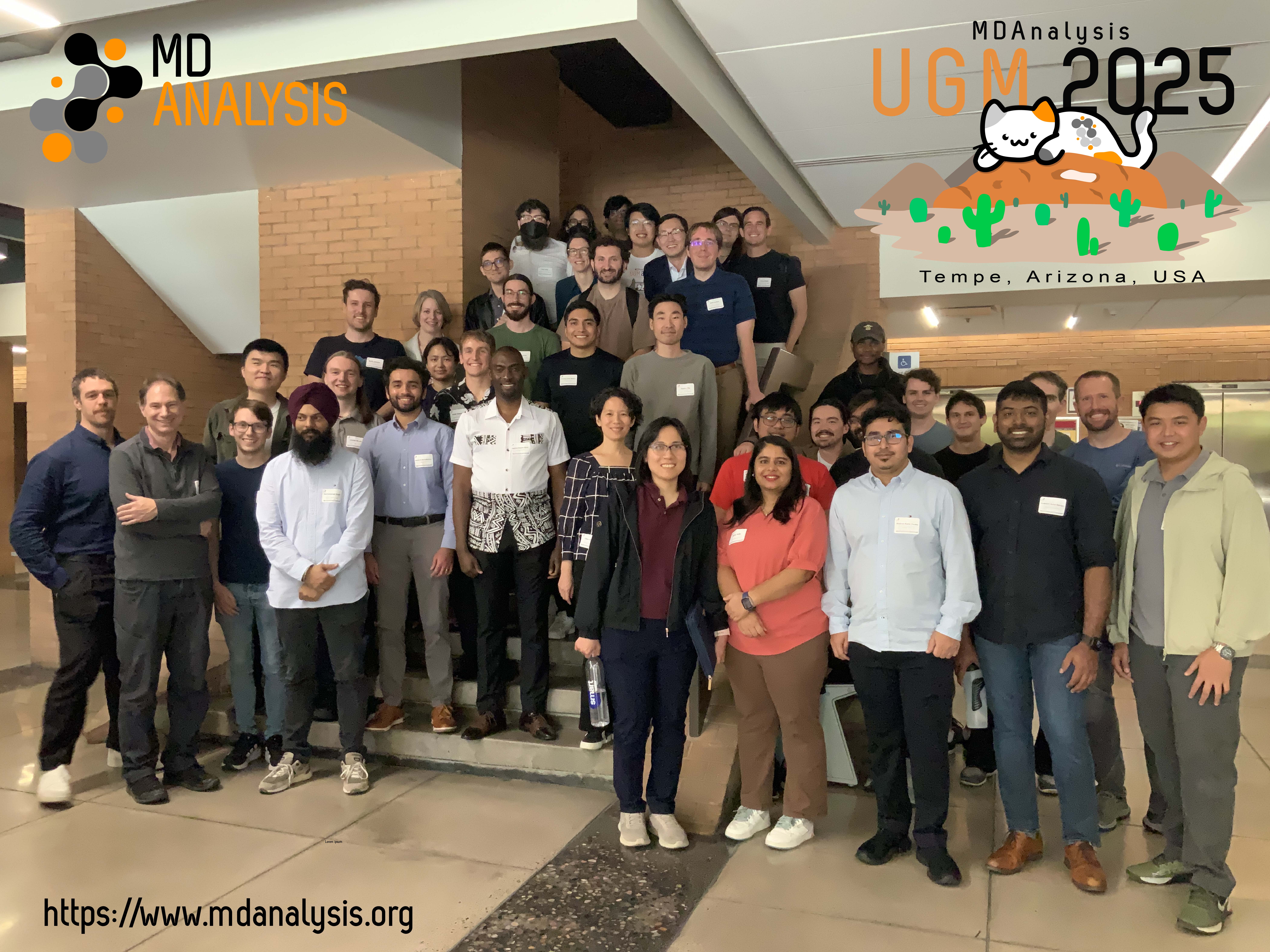
Here’s our quick recap on our community events throughout 2025. Our flagship gathering was the third MDAnalysis User Group Meeting (UGM) in Tempe, Arizona, which brought together researchers and developers for three days of science, tutorials, workshops, and collaboration.
MDAnalysis UGM (User Group Meeting)
From November 9–11, 2025, MDAnalysis users and developers convened in Tempe, Arizona for the third MDAnalysis UGM (User Group Meeting). Hosted at Arizona State University (ASU) in the Center for Biological Physics and Department of Physics, the hybrid-format meeting featured contributed talks, posters, lightning talks, and hands-on workshops. In-person registration reached capacity, and we were grateful for the strong interest from the community; online attendance remained free for those who followed along remotely.
The program emphasized streaming and inline analysis of molecular dynamics trajectories—building on ongoing work supported by a U.S. National Science Foundation Elements award and our December 2024 online streaming developer workshop. Talks and tutorials covered biomolecular simulations, soft matter and materials science, drug discovery, machine learning, visualization, and open-source tooling for molecular simulation analysis.
Keynote Speakers
Two keynote speakers anchored the scientific program:
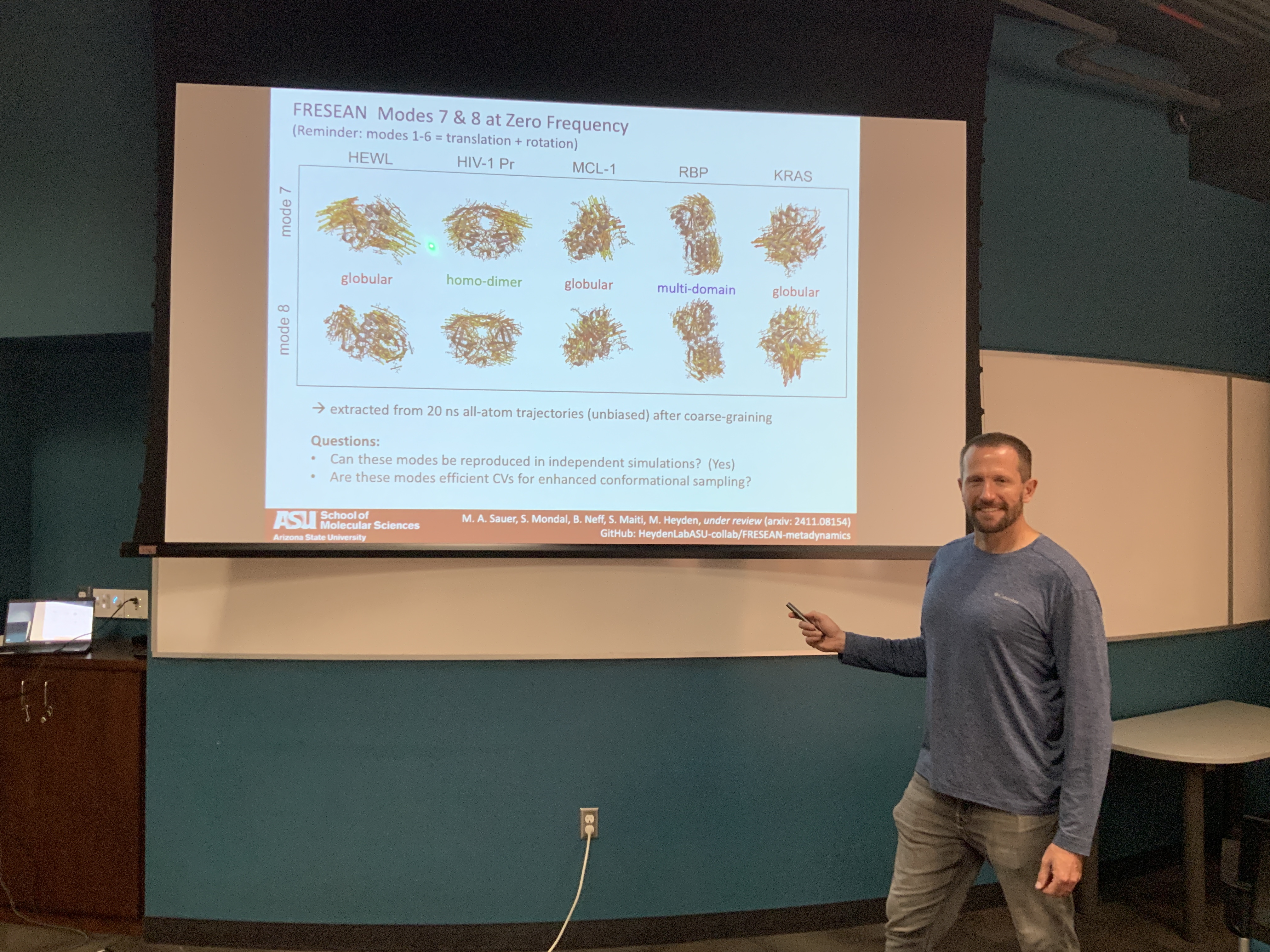
Sunday, November 9 — Dr. Matthias Heyden (Arizona State University) opened the meeting with a keynote on Sub-Picosecond Timescale Information in Microsecond Simulations, highlighting how streaming and interactive molecular dynamics workflows can unlock high time-resolution insight from long simulations.
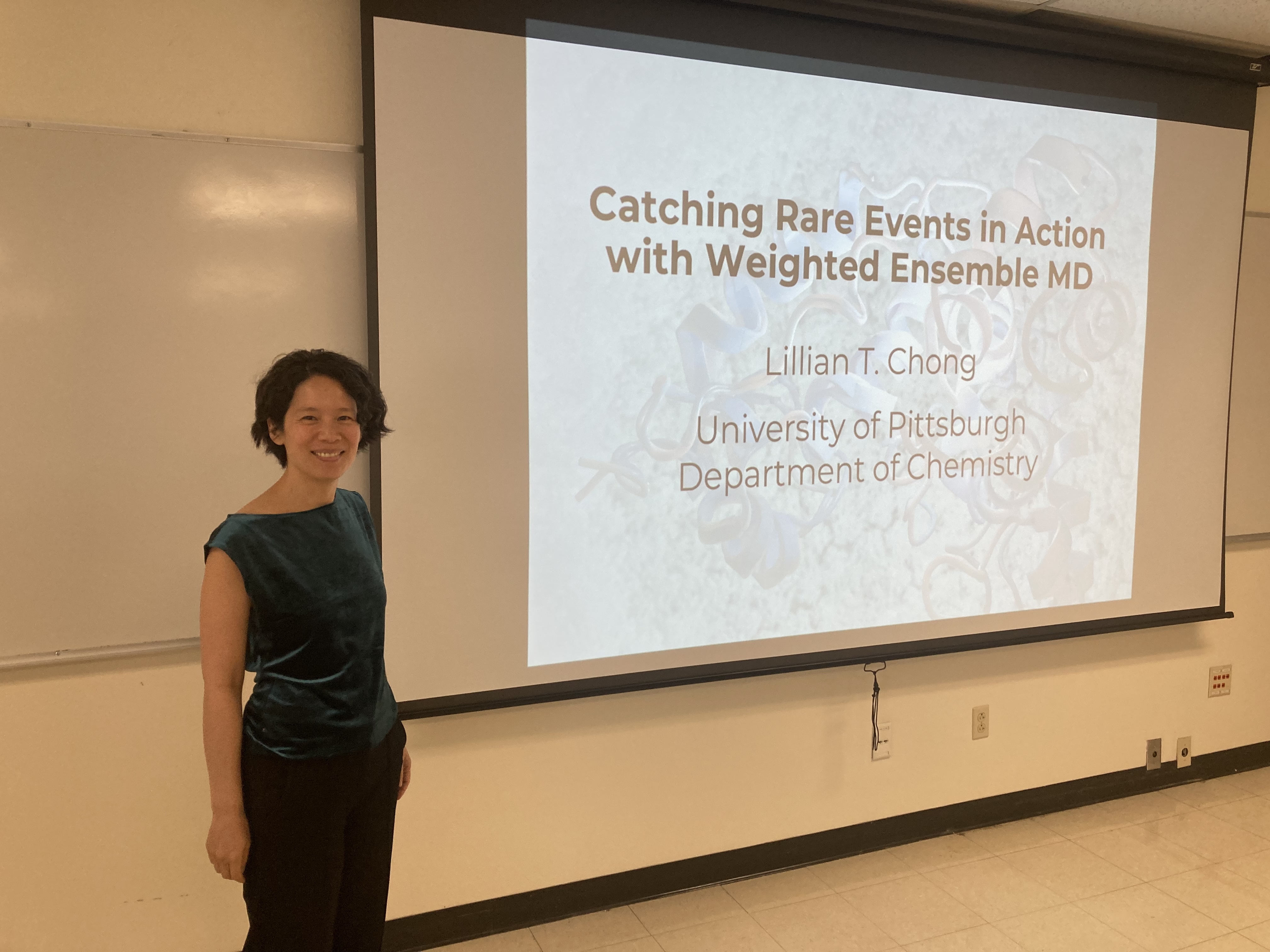
Monday, November 10 — Dr. Lillian Chong (University of Pittsburgh) delivered a keynote on From Protein Structure to Function: Weighted Ensembles Beyond Machine Learning, connecting rare-event sampling with WESTPA and broader biomolecular simulation challenges.
Contributed presentations spanned membrane biophysics, force-field development, enhanced sampling, visualization, MDAKit development, and community infrastructure. Lightning talks on Monday and Tuesday gave early-career researchers and new contributors a platform to share work in a fast-paced format.
We would like to thank our partners and sponsors for helping us make the 2025 MDAnalysis UGM such a success!
The Future of MDAnalysis UGMs
We are grateful to the Chan Zuckerberg Initiative (CZI) and the U.S. National Science Foundation for supporting outreach and streaming-related development that helped make the 2025 UGM possible. As we plan future community gatherings, we continue to seek partners who can help sustain this annual tradition.
Unlike 2024, when we offered four standalone online and hybrid training workshops throughout the year, our primary hands-on training in 2025 took place during the UGM itself. Community partners and the MDAnalysis core developer team led tutorials and master classes across all three days.
November 9: MDAnalysis Streaming Workshop
On the first afternoon, Dr. Matthias Heyden, @amruthesht, @ljwoods2, and colleagues led a streaming workshop on interactive molecular dynamics (IMD) and trajectory streaming in MDAnalysis, including theory, implementation details for IMDv3, live demonstrations, and a hands-on session. The program also featured a talk by @jpkrowe on integrating MDAnalysis streaming analysis with WESTPA propagators—work connected to our Google Summer of Code 2025 collaboration. Materials are available in the Streaming workshop folder and build on the imd-workshop-2024 repository.
November 10: MDAnalysis Master Classes
Monday afternoon featured short master classes from the MDAnalysis core developer team:
Workshop materials for the OpenFF, OpenFE, and OpenADMET sessions are linked from the UGM2025 workshops README.
Acknowledgements
A special thanks goes out to everyone who helped make the 2025 UGM a success, including participants, speakers, workshop leaders, poster presenters, the organizing committee, and our sponsors! If you or your organization are interested in partnering with MDAnalysis to organize future workshops or UGMs, you are always welcome to fill out our Google form or email [email protected].
To stay up-to-date on all MDAnalysis event offerings, be sure to follow our News, LinkedIn, and Bluesky pages.